Communication Studies
What is it?
Communication studies was established as a unique discipline by the National Communication Association in 1914. With the emerging World Wars and developments in communication technology, it became pertinent to study rhetoric. This was used to effectively utilize the media to inform and influence the public, connecting constituents to our government. To this day, those who partake in communication studies seek to understand the way people connect with one another, how rhetoric may influence a message, and how messages are sent between people.
Despite my degree being in psychology, I chose a second major in communication studies because of my love for others. While psychology allows me to understand the way individuals think and behave, communication studies allows me to understand the way individuals interact and connect with one another. Since individuals do not exist in a vacuum, I am able to apply communication studies in all aspects of life. This includes, but is not limited to, developing interpersonal relationships, analyzing and responding to current events, pursuing organizational leadership, and effectively resolving conflict with others.
Learning Outcomes
The College of Communication and Information Sciences at the University of Alabama has established five communication studies learning outcomes. These are skills that a student majoring in communication studies should be proficient in. Below, I have defined each learning outcome, provided an example in which I have applied the specified skill, and explained how my example demonstrates my proficiency in the given learning outcome.

My Research
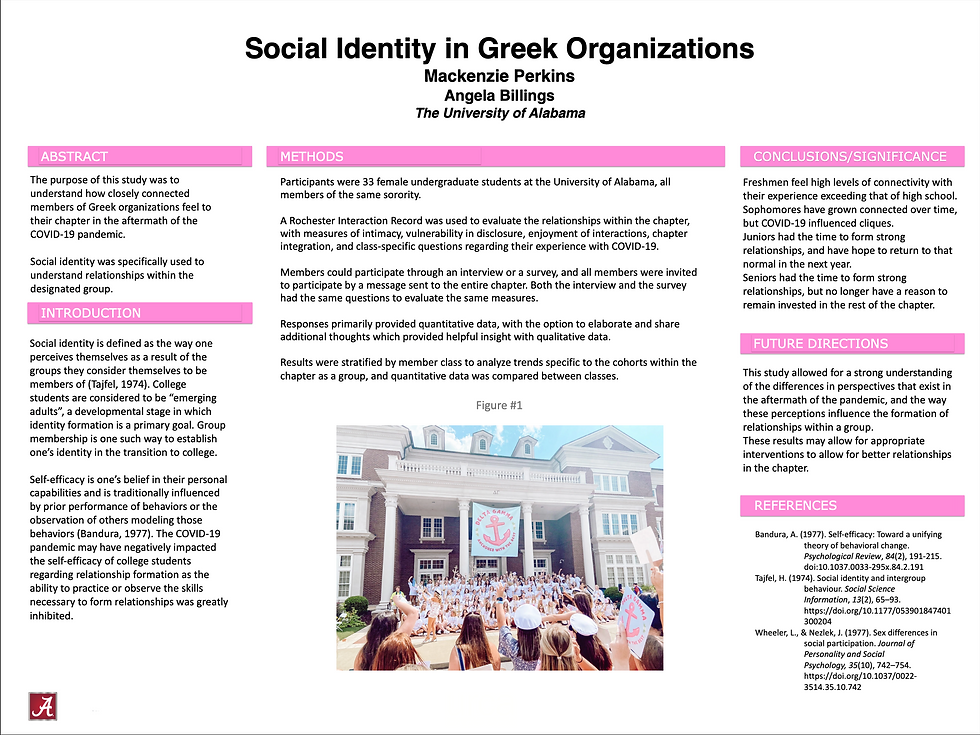
Social Identity in Greek Organizations: The Aftermath of the COVID-19 Pandemic
Brainstorm
When starting my COM 499: Capstone Seminar research project, I knew I wanted to focus on something I was truly passionate about. At the time, all the change in my sorority from COVID-19 was fresh in my mind and I was still in the process of choosing a higher education administration program. It seemed like a natural choice to focus on the impact of COVID-19 on relationships within my sorority.
Theories
Since I wanted to better understand the way individuals perceived in-group relationships in the aftermath of the pandemic, I chose to focus on social identity as my guiding communication theory. Social identity studies how one interacts with other members of the group or those not in the group as a result of one's group affiliation. Since there were clear demarcations between pledge classes due to the difference in experience, social identity theory helped me to understand how the subgroups of each pledge class within the sorority were influencing the overall unity of the chapter.
As a psychology major, I also wanted to include the theory of self-efficacy to better understand how individuals felt regarding their competence in relational formation. Self-efficacy studies how capable one feels in achieving a given task, and is built by prior success in the given task or by observing someone else achieve the given task. I wanted to understand the impact on chapter members' self-efficacy in relationships due to the isolation of COVID-19 and how that then influenced their perceived closeness in relationships within the chapter.
Process
I started by completing an annotated bibliography in which I compiled applicable research that utilized my chosen theories. This was then the foundation of my literature review. I also found a measure called the Rochester Interaction Record which I chose to apply in my own research. This measure allowed me to create the questions I would use in my interviews and surveys.
I focused my research on the population within my own chapter, inviting members to either interview with me or complete a survey with the same questions on their own time. This was a convenient way of gathering participants, and I enjoyed being able to create a space to openly discuss the impact of COVID-19 with the members of an organization I value so dearly. We all had been affected in different ways, and I loved being able to give a voice to the pain that was experienced by the chapter as a whole, yet was still unique to each individual.
Reflection
I am proud of the way this project turned out. My confidence in my ability to pursue research has grown immensely, from the initial concept of this project, to deciding how I wanted to execute my ideas, and finally to its completion. I feel as though I was able to produce a meaningful work that can be applied to improve the relationships in the chapter going forward. The process taught me how I can better understand a group I may work with in the future, to identify where there may be division within the group so that the overall unity can be improved. I am still learning and growing. I hope to have more comprehensive samples in the future, and to strengthen my ability to apply theories in research to produce work that is more cohesive. However, this project is something I was able to start and finish, I saw it through from concept to execution. To me, that is a success.

Inspiration
Coming from Massachusetts to the University of Alabama, I knew I wanted to build strong friendships and get involved right away. After performing as one of Elle Woods' sorority sisters in the musical Legally Blonde while in high school, I decided I wanted to join a sorority myself.
At the beginning of my freshman year, I went through Panhellenic recruitment and found the friendships I had been hoping for. My sorority made a big campus feel smaller, gave me a group to identify with, and allowed me the opportunity to pursue leadership positions within the chapter. My friends weren't limited to the women in my pledge class (members that join at the same time as a cohort), but also the members that were older and younger than myself. I got to learn from those who were older, and mentor those who were younger.
When the COVID-19 pandemic began in the spring of my sophomore year, everything I loved about Alabama was taken away from me, including my sorority. When we finally returned, there were heavy restrictions and things felt entirely different from the chapter we had left. Even in our senior year, my pledge class could feel how our relationships were changed by COVID-19. When talking to younger members of the chapter, it was clear there was a divide between the members that had experienced the chapter prior to the pandemic and the members that joined during and after the restrictions.